Last night I tried to get some sleep before an early start to catch the ferry to Helsinki, Finland. But three “Likely Scam” calls jolted me awake. Needless to say, I needed two strong cups of coffee before heading out the door for a Bolt ride to the ferry terminal, arriving about 45 minutes before the 6 a.m. departure.
Getting my ticket and boarding the ferry were remarkably easy. I’m glad I got there early, though, because the ferry actually left the port 10 to 15 minutes ahead of schedule. I assume that was because all the ticketed passengers had boarded. Still, I would have thought they might leave a little cushion for someone who showed up just before the scheduled departure time hoping to buy a ticket and board.
The two-hour-and-fifteen-minute ride across the Baltic Sea was very peaceful. I spent some time on the sun deck watching the water and clouds meet at the horizon. I also decided to walk around much of the ferry.
Wow. This ferry has a lot of ways to help you part with your euros. There’s a buffet, grocery store, jewelry, bags, perfume, slot machines and multiple lounges. Luckily that morning, I needed nor wanted any of that.
The ferry arrived in Helsinki a little ahead of schedule. I decided to walk the roughly two miles to Senate Square, where my walking tour was meeting, so I could get a feel for as much of the city as possible during my short visit.
Along the way, I decided another cup of coffee and a pastry were in order, so I ducked into the first open café I found. I left the café with enough time to make it to Senate Square and check in for my tour.
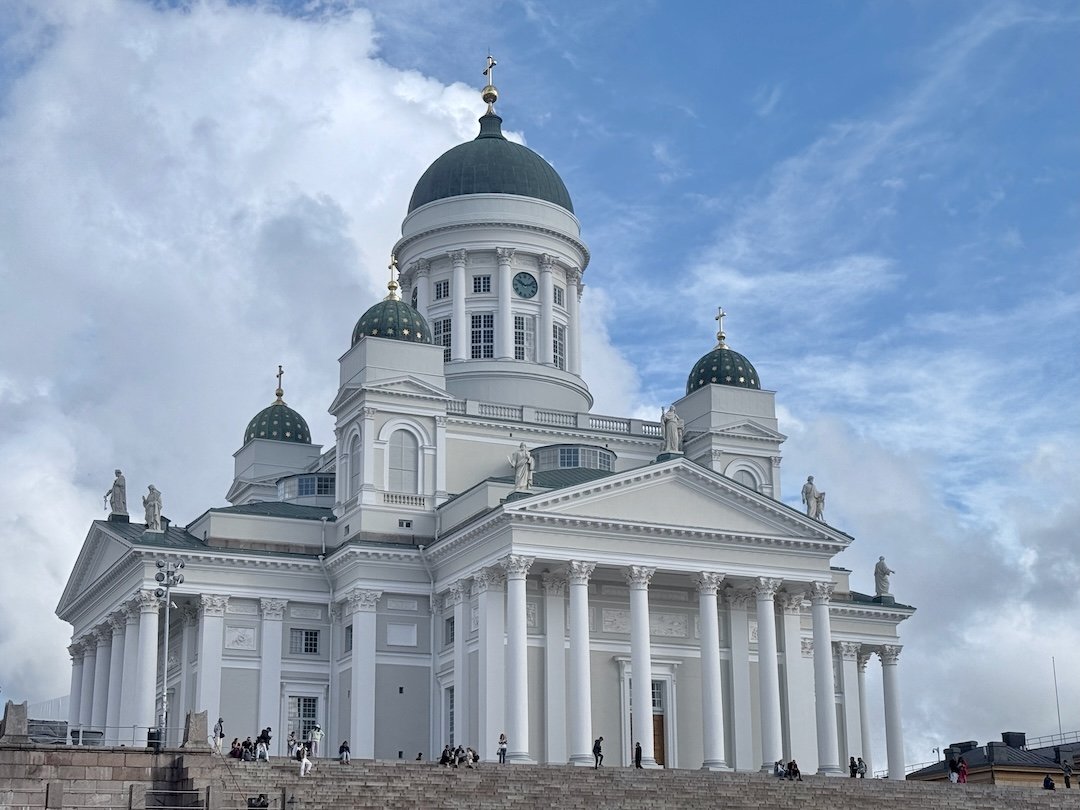
The first thing our guide pointed out was Helsinki Cathedral. Although it is Lutheran, its exterior looks more imperial than what many of us might associate with a Lutheran church. That’s no accident. The cathedral was designed by Carl Ludvig Engel as part of the grand Neoclassical—and specifically Empire-style—center of Helsinki. It was originally known as St. Nicholas’ Church, a name honoring Tsar Nicholas I.
The result does, indeed, look like something that might belong in St. Petersburg. Inside, however, things become considerably more restrained. You know—more Lutheran.
This provided our guide with a segue into the Vikings. He noted that although Vikings raided and traded throughout the Baltic region, Finland was not a major target for Viking raids. His explanation was that Finland lacked some of the resources and wealth that Vikings were seeking elsewhere, and that Lutheran churches—which came much later, of course—didn’t have the treasures associated with Catholic churches.
That last part made me pause. The Vikings and the Reformation were separated by several centuries, so I’m pretty sure our guide was making two separate historical points rather than suggesting Vikings avoided Finland because Finnish churches weren’t filled with Catholic treasure. I decided to let that one go.
Okay, readers, here comes the part where I use Google to fact-check both the tour guide and my memory.
Ed, our guide, mentioned Carl Ludvig Engel several times. He said Engel designed hundreds of buildings in Helsinki. My quick research turned up more conservative numbers, particularly when referring to his major public buildings. What isn’t disputed is Engel’s enormous influence on the city center. He designed many of the buildings surrounding Senate Square and helped create the Neoclassical character that still defines much of central Helsinki. Many of Engel’s buildings are painted in the pale yellows, pinks and whites that give this part of Helsinki such a distinctive appearance.
As we walked through the center of the city, our guide pointed out another quirky feature: the street signs.
Helsinki is officially bilingual, with Finnish and Swedish used on its street signs. Our guide also pointed out small animal symbols incorporated into some of the signs. He explained that these symbols were intended to help people navigate the city at a time when not everyone could read.
Some parts of the city use different animal themes, including domestic animals. And apparently one of those animals is a unicorn. Why? Your guess is as good as mine.
Next we stood on a corner where we could see two distinctive buildings and the SkyWheel.
The first was Uspenski Cathedral, the large red-brick Orthodox cathedral overlooking Helsinki’s harbor.
The second was the former Stora Enso headquarters, better known locally as the “Sugar Cube.” Designed by Alvar Aalto and completed in 1962, the building is clad in white marble. It has long been controversial. Critics have argued that the modernist building doesn’t fit comfortably with the historic surroundings of the harbor.
Our guide told us that Aalto was trying to bring a Mediterranean feeling to Helsinki and that the marble has required significant preservation because of Helsinki’s freeze-thaw cycles. The marble certainly has a history of maintenance issues.
The SkyWheel initially doesn’t look particularly remarkable. Then you notice that one of the gondolas is made of wood. Yep. It’s a sauna.
Helsinki takes its sauna culture seriously. Finland has more than three million saunas for a population of roughly 5.6 million. It’s widely reported that Helsinki has more saunas that registered cars!
Our tour next passed Helsinki City Hall and Market Square, where we stopped at one of the city’s most famous pieces of public art: Havis Amanda.
Havis Amanda is a nude female figure standing atop a fountain, created by Finnish sculptor Ville Vallgren. The sculpture was completed in Paris in 1906, brought to Helsinki, and unveiled in 1908.
It caused quite a stir.
The controversy was not simply a battle between conservatives who objected to nudity and liberals who objected to the objectification of women, although there certainly were criticisms along those lines. The work was also criticized for its strong European influences and for not reflecting what some Finns of the time considered authentically Finnish culture.
Vallgren himself tried to explain the the meaning of sculpture, which I can’t verify, but it apparently worked. Eventually, the controversy faded, and Havis Amanda became one of Helsinki’s most beloved symbols. Today, she is the center of the city’s May Day celebrations, when university students place a student cap on her head.
Nearing the end of our tour, we passed the railway station—I love European train stations—and stopped near three very different buildings.
The first was the Finnish Parliament House. What caught my attention wasn’t so much the building itself as the public space nearby and what it says about democracy. The Parliament House sits near Citizens’ Square, an area that regularly hosts public demonstrations. I like the symbolism: the people get a place to gather and make their voices heard within sight of the country’s legislature.
Next was Sanoma House, home to the offices of major Finnish newspapers, including Helsingin Sanomat. The building’s extensive use of glass gives it a remarkably open appearance, and its public passages and central Media Plaza were designed to connect the building with the surrounding city. Our guide described the transparency of the building as a metaphor for the transparency of the press. I couldn’t verify that this was the architect’s explicit original intention, so I’ll give Ed credit for the interpretation rather than presenting it as established fact.
And finally, we reached Helsinki Central Library Oodi. This might have been my favorite stop.
Oodi was designed by ALA Architects, who won an international architecture competition in 2013. But what really interested me was how much the public participated in deciding what the library should be. More than 2,300 ideas were collected from Helsinki residents during the planning process. People were asked what they wanted from their central library, and the answers went well beyond “books.” Residents wanted a place for families, learning, events, digital services, meeting people and simply spending time.
And you can see those ideas in the building. Oodi has books, of course. But it also has cafés and restaurants, meeting spaces, studios, gaming rooms, workspaces, makerspaces and 3-D printers. The second floor is essentially a giant playground for making, learning and doing things. The third floor is the quieter “Book Heaven,” filled with books, reading areas and places to sit and take in the city.
In other words, they didn’t just build a library.
After the tour ended, I quickly grabbed some lunch from a grocery store, ate it outside on what Ed described as one of Helsinki’s most beautiful days, and then summoned a Bolt to take me back to the ferry terminal for the return trip to Tallinn.
I had more than two hours on the way back, which gave me time to read and then spend some time on the crowded—and aptly named—Sun Deck.
Not a bad way to spend a day in Finland.