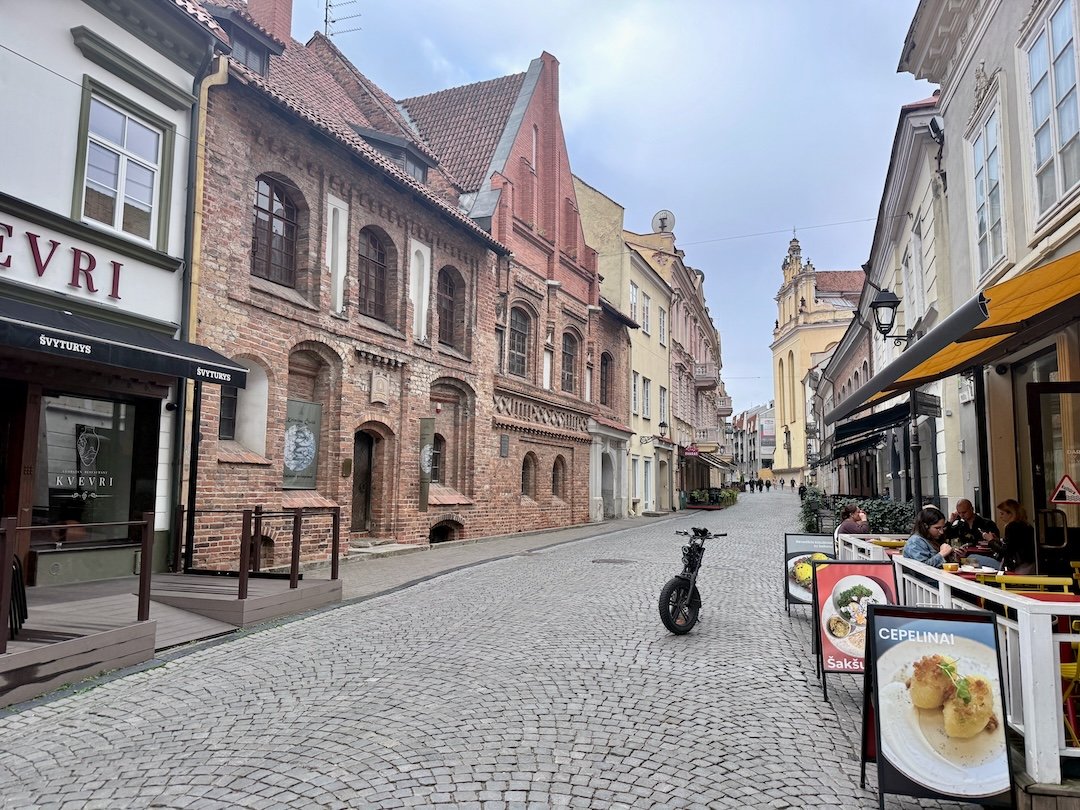
I am staying in Vilnius’s Old Town, one of the largest surviving medieval old towns in northern and eastern Europe. Yesterday, I intentionally avoided exploring much of it because today I planned to see it for the first time as part of a guided tour.
Before the tour, I stopped once again at Crustum, a Lithuanian café and bakery chain. Once again, I was impressed by the music selection. Today, they played the Cocteau Twins, a group that helped define the shoegaze sound. For those unfamiliar with the band, lead singer Elizabeth Fraser became known for using glossolalia—nonsense words and sounds that convey a mood more than a literal lyrical meaning. The Cocteau Twins formed in 1979 and, although they are often associated with shoegaze, also have roots in post-punk. They continued making music until 1997. For a more contemporary example of the same technique, think Sigur Rós.
I ordered an Americano and a small quiche while listening to songs I have known for years but have somehow managed to forget. That’s got to change.
Then it was off to the guided tour.
Our guide’s name means “Fire,” so that’s what we called her. She packed a remarkable amount of information into our walk through the Old Town.
I learned, for example, that Lithuania has more dogs than children under the age of 15. That seems like a problem for a country that needs more young people, and Lithuania appears to recognize it as one. The country has adopted a number of strongly pro-child policies, including guaranteed financial support and paid parental leave. Parents even receive paid days off each month, with the amount increasing roughly with the number of children in the family. Lithuania pays for these and other programs through a relatively high tax, which approaches 46 percent.
The country also faces a shortage of workers. That shortage has helped Lithuania avoid some of the stronger anti-immigration backlash found elsewhere in the world. Still, the government has not embraced permanent settlement for all immigrant workers. Instead, it seems to be trying to balance the need for workers with questions about immigration policy and how long people should be allowed to stay.
The exception, at least in terms of both policy and public sentiment, appears to be Ukrainians fleeing the war. Lithuania has welcomed Ukrainian refugees more openly than many other European countries, both through government policy and through efforts to integrate them into Lithuanian society.
Our guide also took us back through the country’s complicated relationship with religion. During the Soviet occupation, the government closed or repurposed many religious institutions. One church, for example, became a museum of atheism. When Soviet rule ended, the building returned to its original purpose as a church.
The end of Soviet occupation created some other unusual situations, too. For a short time, people weren’t entirely sure what the new rules were—or perhaps they simply decided that the old rules no longer mattered. A community of artists took advantage of the confusion and established their own little republic within Vilnius.
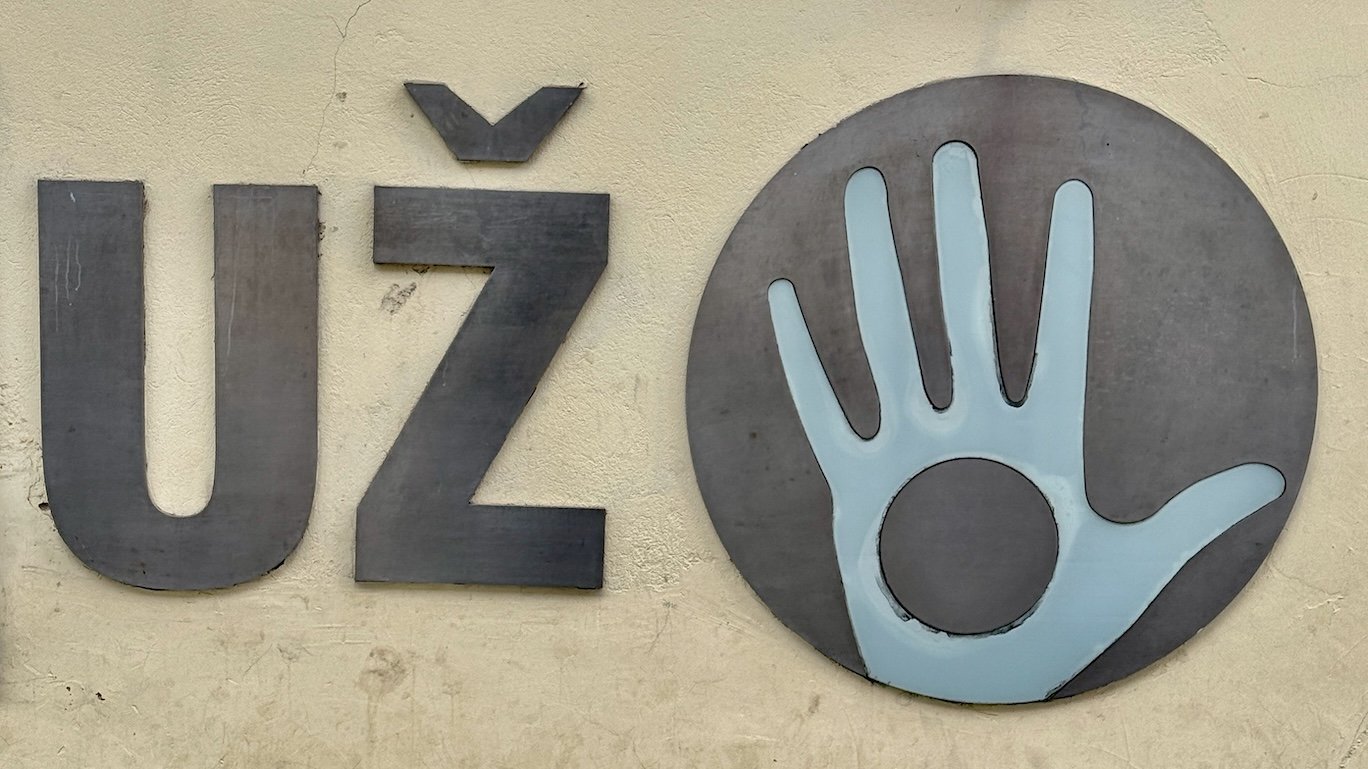
Today, Užupio Res Publika—roughly, “the Republic Beyond the River”—has its own borders and constitution. Tourists can buy a copy of the constitution and have it stamped, kind of like a passport. Our guide gave us one important warning, though: do not put the Užupio stamp in your actual passport. Apparently, other countries do not appreciate finding evidence that you have visited a country that technically doesn’t exist.
And then there is the swing.
Hanging from a bridge on the “border” between Užupio and Lithuania, a swing dangles over the river. The Anonymous Swing Foundation takes credit for putting it there. I have no idea what qualifies someone to join an organization called the Anonymous Swing Foundation, but I quite liked the very public art they installed.
By the end of the tour, I had accumulated more information than I could possibly process at once. So I returned to my apartment, had some lunch, and sat down to write this post (with some help from Google) before heading back out to explore a little more.
There is still plenty of Vilnius left to discover.
(If you like what I wrote here, I encourage you to visit yesterday’s post on michaelspheres. I share more of my story as the day progressed.)