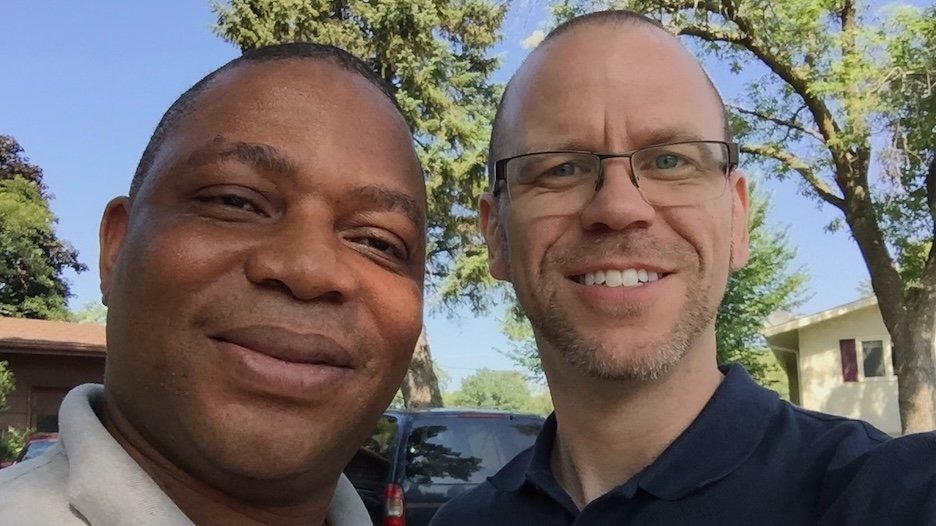
Today, I found myself thinking about Richard Sondah, someone I worked with during my years as executive director of the Minnesota Coalition for the Homeless (MCH). Although we were no longer working closely together when he died, I still vividly remember hearing the news. My immediate thought was that the world had lost someone it still desperately needed.
I write this because Richard deserves to be remembered.
I first met Richard in the fall of 2006. He was pursuing a Master’s in Public Administration at Hamline University and contacted me about interning at MCH to learn more about the nonprofit sector. We met, and I asked him to help make the case for increased funding for Minnesota’s homelessness prevention programs.
Early in his internship, I invited Richard to join me for a meeting with Representative Tony Sertich, who was about to become House Majority Leader. Rep. Sertich had long carried legislation for MCH, and I wanted Richard to hear firsthand how relationships between advocates and policymakers could work.
The meeting was warm, practical, and generous. Rep. Sertich offered strategic advice and suggested who might be better positioned to carry our legislation now that his new leadership responsibilities would demand more of his time.
As we left, Richard remarked that a meeting like that would never have happened in his homeland.
At the time, I didn’t know him well enough to appreciate the weight of that comment. I was in a hurry and simply shifted the conversation back to our legislative strategy. Looking back, I wish I had asked more questions.
Even then, though, Richard stood out. Whether he was writing, speaking, or analyzing an issue, he possessed a remarkable ability to strip away distractions and identify what truly mattered. He instinctively found the heart of a problem.
When his internship ended, Richard explained that he wanted to continue helping MCH but couldn’t promise much because of obligations back home. He was a respected leader in Minnesota’s Liberian community, and those responsibilities regularly took him back to Liberia.
A month or two later, I had just stepped out of a meeting with a legislator when my cell phone rang. The caller ID read “Liberia.” I almost let it go to voicemail—I was busy—but then I thought, “How often does someone call you from Liberia?”
I answered.
Richard simply wanted to know whether he could help MCH again when he returned. I told him I would be delighted.
Over the following months, Richard volunteered with at MCH, and I came to know him much better. The more time we spent together, the more I trusted his judgment.
When MCH secured funding to hire an office coordinator, I knew Richard was the right person for the job. It remains one of the best hiring decisions I ever made.
Richard possessed an extraordinary intuition about people. After only brief interactions with colleagues or partners, he would quietly share what he believed motivated them. More often than not, he was right. His insights weren’t cynical or manipulative; they reflected an uncommon understanding of human nature.
One day, while driving home from an MCH conference, Richard told me more about the life he had left behind.
Before coming to Minnesota, he had been part of Liberia’s pro-democracy movement. He described hiding with fellow activists while fleeing the forces of Charles Taylor’s dictatorship. He spoke about running from gunfire, taking refuge in dangerous terrain, and losing friends—and even his beloved dog—in the struggle.
He also told me about something that once seemed impossible: the election of Ellen Johnson Sirleaf as Liberia’s democratically elected president.
After democracy returned, Richard continued serving his country. He worked to strengthen civic life in practical ways, even serving as a soccer referee because he believed sports could teach fairness and respect for rules. He told me stories about organizing church members to stand up to corrupt local leaders and helping ordinary Liberians believe that honest government was possible.
As I listened, I slowly realized something that humbled me.
On paper, I was Richard’s supervisor.
In every way that truly mattered, I was learning from him.
His principles had been tested in ways that most Americans will never experience. He had risked his life for democracy, justice, and the belief that ordinary people deserved freedom. Yet he never carried himself as a hero. He was deeply humble, endlessly curious, and unfailingly kind.
Years later, when Ebola devastated Liberia, Richard returned to help his country once again.
Through his Facebook posts, I followed the heartbreaking realities he faced. Hundreds were dying. Thousands more were sick. Fear threatened not only public health but Liberia’s fragile democracy, as opportunists sought to exploit the crisis for political gain.
I asked Richard what I could do to help. I told him I would contact my members of Congress, my senators, and even the White House with whatever message he wanted me to deliver.
He had one request: America needed to sustain its commitment to fighting Ebola in Liberia, Guinea, and Sierra Leone. It needed to continue developing vaccines until, in Richard’s unforgettable words, we could “MAKE EBOLA HISTORY.”
True to his gracious nature, Richard also made sure to acknowledge what the United States had already done. American personnel had helped build treatment centers and provide desperately needed assistance. He believed those efforts were making a difference and that the tide was beginning to turn.
I kept my promise. Along with many friends, I contacted elected officials and shared Richard’s message.
After that, our interactions continued mostly through Facebook. Every exchange with Richard left me encouraged.
Then they stopped.
Some time later, I learned that Richard had died.
I grieved the loss of our occasional phone calls from Liberia, our long conversations over coffee whenever he returned to Minnesota, and the thoughtful advice he always seemed ready to offer. But more than anything, I missed simply being in his presence.
Richard possessed a quiet greatness.
He had faced dangers that most of us can scarcely imagine, yet he never lost his humility, optimism, or compassion. When MCH went through difficult financial times, Richard never minimized anyone’s worries. Instead, he offered perspective. Having endured civil war, dictatorship, and violence, he knew that even difficult moments could be survived. His courage allowed him to reassure others without ever dismissing their fears.
There is one memory of Richard that still makes me smile.
He loved Christmas music.
One year I made him a mixtape of Christmas songs. When I handed it to him, his face lit up with childlike joy. He played that CD over and over again.
That image has stayed with me.
When people speak of courage, they often imagine dramatic acts performed by larger-than-life figures. Richard taught me that real courage often lives inside gentle people—people who fight for justice without seeking recognition and who carry enormous burdens with grace.
The world still needs people like Richard Sondah.
I’m grateful that, for a few years, I had the privilege of working beside him.