When you think of “home,” what comes to mind? What memories surface first?
Those are two of the questions I’ve been asking scores of people over the past several months as part of a project to document how people define the meaning of home.
I also ask what they think about low-wage workers struggling to afford housing and about the dramatic rise in homelessness over the past three decades.
What I’ve discovered gives me hope.
Talk About Home demonstrates that people are ready to rally behind meaningful changes to housing policy and to demand an end to homelessness.
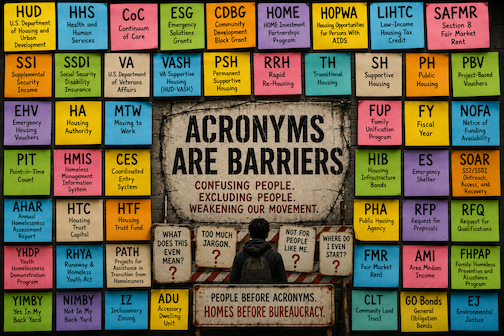
The people I interview don’t talk about infrastructure bonds, tax credits, or financing mechanisms. They don’t know what acronyms like ROI or FHPAP stand for.
But they understand the housing crisis intimately.
They are struggling to pay rent or mortgage payments themselves, or they know someone who is. They volunteer at homeless shelters. They’ve watched family members lose housing. Some have experienced homelessness firsthand.
Perhaps I should explain how the project works.
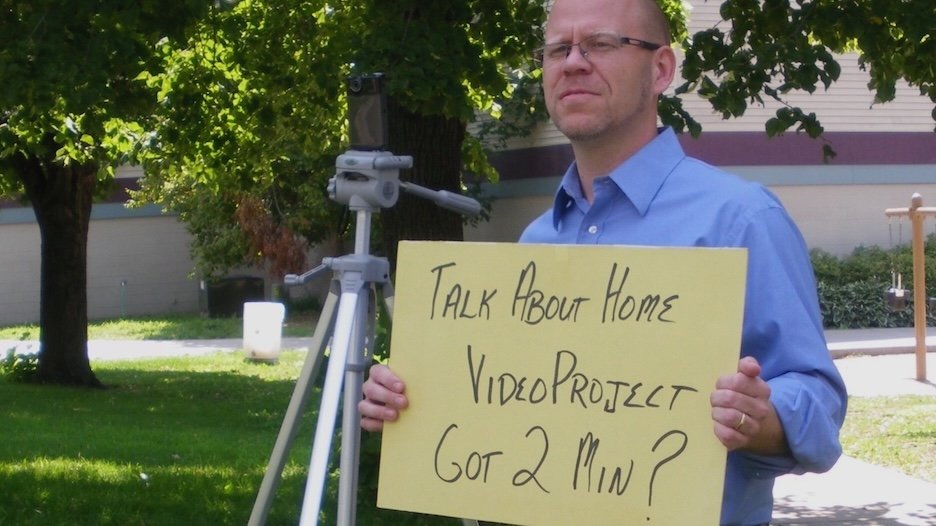
Two or three afternoons or evenings each week, I head to a public place with a video camera, tripod, and a handmade sign that reads:
“Talk About Home video project… Got 2 minutes?”
Then I wait.
Almost every time, someone approaches and asks, “What are you up to?” Others simply smile and say, “I’ve got two minutes.”
Without giving them time to prepare or rehearse, I tell them I’m interviewing people about the meaning of home.
Then I press record.
So far, I’ve interviewed 105 people.
The conversations have been beautiful, empowering, and, at times, heartbreaking.
The beauty comes first.
Ask someone about home, and they often smile before they even answer. Food and family come up again and again. So do safety, belonging, and “the place where I can be who I want to be.”
Sometimes people spend several minutes reminiscing about baking cookies with their mom, neighborhood gatherings over soda—or pop, depending on where they’re from—or a treasured painting discovered in a basement.
For a few moments, they return to another time. Another place.
Then the conversation shifts.
When I tell people that it takes more than two full-time minimum-wage jobs to afford a modest apartment in many communities, they rarely question the statistic. One person simply asked, “Are you sure it’s only two?”
Some describe their own struggles to keep up with housing costs. Others talk about working extra hours that should be spent with their children or loved ones, but can’t be because making rent comes first.
What surprises me most is how readily people connect these personal stories to larger systemic problems.
Joe captured what many interviewees expressed:
“I know when I grew up my father worked and my mother… she worked at home but she didn’t have an actual income. Then society changed to the point where now mom and dad both have to work. And now it’s gotten to where mom and dad both have to work and they still have trouble meeting expenses. Society has changed somehow.”
The conversations become even more sobering when I share that homelessness in Minnesota has quadrupled over the past 20 years.
One young woman told me that, as a child, she had been proud to live in a state where homelessness seemed rare. She was deeply shaken to learn how much things had changed.
A foster mother immediately responded, “Yep. I can talk about that, too.”
She had struggled to keep housing herself. Three of the four children in her care had experienced homelessness with their biological mother before coming to live with her. One child refused to eat baloney because it reminded her of eating it constantly while homeless. That same child talked about sleeping in abandoned buildings and living under a bridge in a car with her family.
Those stories stay with you.
Fifteen people I’ve interviewed have experienced homelessness themselves. I’d estimate that just as many know someone who has.
Affordable housing and homelessness are no longer abstract policy debates for most people. They are lived experiences. They affect families, friends, coworkers, neighbors, and communities.
People understand what’s happening.
More importantly, they understand that it doesn’t have to be this way.
As one interviewee, Tim, put it:
“Nobody would come out and say they want people to be homeless… but it all depends on whether they’re willing to do anything about it.”