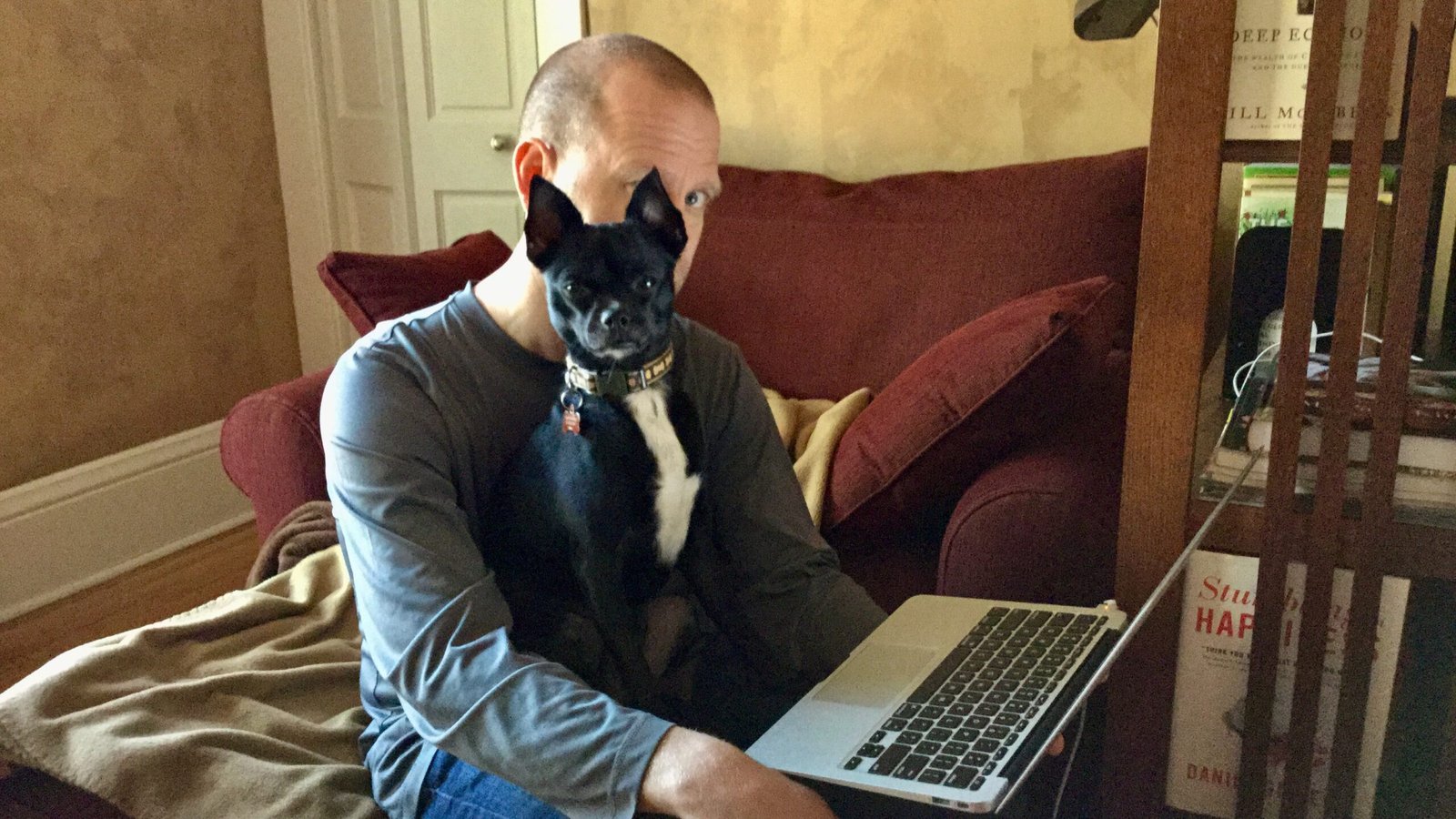
A few weeks ago, I shared that my puppy Franco and I take long walks every Saturday and Sunday morning. We use that time to solve the world’s problems—or, more accurately, I try to solve them while giving Franco plenty of opportunities to pee and poop.
During those walks, we often talk about food justice. After spending months sprinting through lawns and gardens, Franco has become surprisingly knowledgeable about why our food system needs to change.
Today’s conversation, though, started on a much more hopeful note than the one we had a few weeks ago.
For one thing, my mood was different. I’ve been carrying around more anxiety than I’d like lately, but this morning I woke up determined to look for reasons to hope instead of reasons to despair.
That hope appeared just a few minutes into our walk.
Growing through a crack in the sidewalk was a lone dandelion.
Immediately, my mind drifted back to something I’d written earlier this week. “I don’t believe in miracles. I’m not religious. But seeds make me believe in something: there is always reason for hope.”
That’s exactly what the dandelion represented.
Just as Franco prepared to mark it as his own, I shouted, “Whoa! Leave that one alone, Dude!”
He looked at me with obvious disappointment.
“Seriously,” I continued. “Most people see a weed. I see a completely edible plant growing in one of the most inhospitable places imaginable.”
Somehow, a tiny seed had landed where there was almost no soil, managed to send roots deep enough to survive, and was now happily doing what dandelions do best: refusing to give up.
Franco cocked his head, glanced at the dandelion again, then gave me the universal “Treat…or else” look.
I handed him a treat.
He graciously redirected his attention elsewhere.
“So,” Franco asked, “what’s got you so worked up about one dandelion?”
“Okay,” I admitted, “this is going to sound like a huge tangent. But that little plant makes me think our cities could become much more hospitable places for growing food—especially food for people who need it most.”
“The dandelion gave you that idea?” Franco replied.
“Think about it. Our cities are covered in concrete. Yet because our infrastructure is aging, cracks appear everywhere—and wherever there are cracks, something finds a way to grow. Dandelions survive despite our constant attempts to eliminate them. Every part of the plant is edible. The roots can substitute for coffee. The young flowers can go into salads. And apparently—though I can’t personally verify this—people even make dandelion wine.”
“I suppose that’s interesting,” Franco said. “But dandelions aren’t going to solve hunger.”
“You’re absolutely right,” I answered. “The dandelion isn’t the solution. It’s the metaphor.”
I pointed toward the neighborhood around us. “Look at all this space.”
Lawns. Boulevards. Vacant lots. Unused corners. Flat rooftops.
“So much of our urban landscape grows grass because that’s what we’ve decided cities should look like. But imagine if at least some of those places grew food instead.”
Franco wasn’t convinced.
“That’s easy for you to say,” he barked. “You have raised beds, good soil, access to water, and money to buy quality seeds. Many of the people you care most about don’t have any of those things.”
He had me there.
“You’re right,” I admitted. “Access is the real issue.”
For a minute we walked in silence.
Then the thoughts started tumbling out.
People donate money to feed hungry children. They donate money to save bees. They spend extraordinary amounts of money eating heirloom vegetables at upscale restaurants. Many proudly call themselves ‘foodies.’ And generous people also support homeless shelters and affordable housing organizations. I know—they support organizations like the one where I work.
What if we connected all of those instincts?
What if people saw growing food not simply as gardening, but as infrastructure for justice?
“Listen, Franco,” I finally said, “I don’t have the answers. Not yet. But I know the questions I want to ask.”
How do we get good seeds, healthy soil, and reliable water to the people who need them most?
How do we transform abandoned lots, empty boulevards, rooftops, and neglected corners into places that produce fresh food instead of just taking up space?
How do we build systems that don’t just feed people today, but continue feeding communities for generations?
“Did you know,” I added, “that some airports now keep bees on otherwise unused land? Somebody looked at empty space and asked, ‘What useful thing could happen here instead?’ That’s the kind of thinking I want us to apply to our cities.”
Franco looked at me.
Then he looked at our front steps.
“Our walk is over, Mr. Dahl,” he said. “Interesting ideas. But you’ve still got a long way to go before you’ve figured out how any of this works at scale.”
“Yep,” I replied.
“I’ll keep thinking. I’ll talk to some smart friends.”
“And next Saturday…” I smiled at him. “…We’ll continue the conversation.”
Franco tilted his head.
Then he barked insistently.
I handed him another treat.