To begin, I want to say to everyone who wished me a happy birthday yesterday: Thank you! I started receiving kind words during the last couple of hours of my nine-hour bus ride from Vilnius, Lithuania, to Tallinn, Estonia. Not only did you all help me feel the love from friends and family, but you also made the end of a long ride much more interesting.
A special thanks to Rebecca. “Sweetie, you helped rally folks on your Facebook page. What! You never put anything on your Facebook page. I love you!”
Now, as a precursor to today’s post, I need to note that the forecast called for rain in the morning and blue skies in the afternoon. Things seemed to clear up pretty quickly, so I left the umbrella and raincoat back at the apartment. I figured I could grab an Americano, reassess the weather, and then head to my 11 a.m. guided tour of part of the Old Town. My Airbnb was only a few minutes from where the tour began, so I could collect a coat and umbrella if needed.
So I spent about an hour sipping my coffee while reading more of Heather Cox Richardson’s Democracy Awakening and listening to some pleasant jazz in the background. I left just about when the tour was supposed to begin.
Blue skies. No reason to turn back for rain gear.
Our tour began with the guide asking whether we knew what “Tallinn” meant. Someone in the group answered, “It’s Estonian for ‘Danish City.’”
Bingo.
For those of you who don’t remember your world history classes in high school, the Danes were some pretty formidable explorers, conquerors, and colonizers back in the day.
The name Tallinn is generally understood to derive from Taani linn, meaning “Danish city” or “Danish town,” a reference to the Danish presence here after King Valdemar II conquered the area in 1219. Over the centuries, Tallinn would come under the rule of Denmark, the Teutonic Knights, Sweden, the Russian Empire, independent Estonia, Nazi Germany, and the Soviet Union. In other words, this place has changed hands quite a few times.
And with all those wars, occupations, and changes in political power came destruction, rebuilding, and, eventually, restoration.
Take Viru Gate. The gate was part of Tallinn’s medieval defensive system, but as the city modernized and entrances needed to be widened and portions of it were demolished or moved.
So, yes, Tallinn’s Old Town really is old. But “old” doesn’t mean that every stone has been sitting exactly where it was put in the Middle Ages. The city has been rebuilt and restored repeatedly over the centuries.
Two particularly destructive periods stand out. During the Reformation in 1524, Protestant supporters ransacked several Catholic churches. Then, in 1684, a massive fire devastated much of Toompea, destroying a large part of the medieval settlement there. And World War II brought still more destruction, including a devastating Soviet bombing raid in 1944.
Okay, rewind.
Back to those Danish folks.
Actually, the next part of the story belongs less to the Danes and more to the merchants of the Hanseatic League. Tallinn became an important center of international trade, and merchants, craftsmen, religious orders, local government, and armies all had roles in making the medieval city function.
And then there were the monks.
The monks who lived in the St. Catherine’s Monastery complex apparently had a variety of ways to support themselves. They farmed, traded fish, and—get this—ran a brewery that produced four different types of beer.
Now, I’ve never been a drinker, so I don’t know my beer. But I found the idea of medieval monks running a brewery pretty amusing. But, hey, they had bills to pay.
If you ever find yourself in Tallinn, make sure you visit St. Catherine’s Passage. It is a beautifully preserved medieval lane running alongside the remains of the monastery. It has cool arches, old stone walls, and artisan workshops.
And then there are the tombstones.
Several medieval carved stones, including tombstones, have survived as part of the monastery complex and walls.
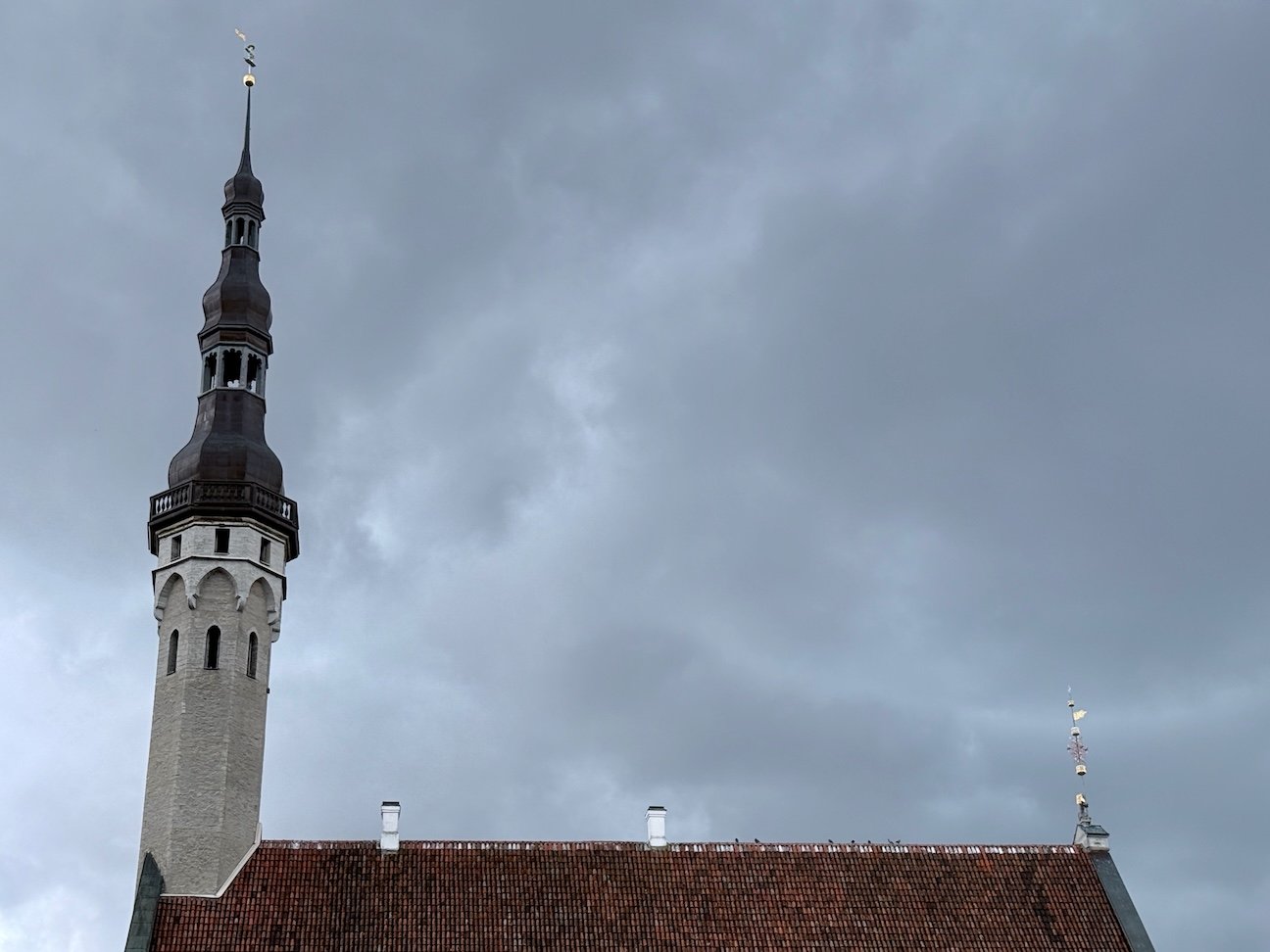
From St. Catherine’s Passage, we headed to the Town Hall Square.
Apparently, everything happened there.
Merchants sold goods. People gathered. Officials conducted business. Religious life played out nearby. And, when necessary, soldiers protected the city and its inhabitants—at least until somebody with a bigger army showed up.
The square has been the marketplace and center of Tallinn’s Lower Town since the Middle Ages. And sitting right there is another piece of history: the Town Hall Pharmacy.
This isn’t a museum pretending to be an old pharmacy.
It’s an actual pharmacy.
The Raeapteek, or Town Hall Pharmacy, is the oldest pharmacy in Europe to have continuously operated in the same premises. Its exact founding date isn’t known, but town records (and Google) show that it already had been operating in 1422.
Of course, medieval medicine was a little different from what we have today.
The pharmacy sold all sorts of herbs, spices, teas, and other stuff—including mummy powder.
Wait! What?
Medieval European medicine sometimes used powdered mummy or mummy-derived material as a supposed medicinal treatment. I was told that the pharmacy had obtained mummies from Egypt and used the powdered remains in medicinal pastes. Whether every detail of that story is exactly as colorful as the guide told it, the broader practice of using powdered mummified remains as medicine is, unfortunately, very real.
Oh, oh.
The blue skies were gone.
It started to drizzle.
Almost everyone in my group pulled out an umbrella, a raincoat, or both.
But it was just a drizzle, right?
Next, we went to a smaller square. On one side stood the city’s oldest continuously operating café, Café Maiasmokk, which dates to 1864.
Our tour guide was about to say more when a horse-drawn carriage started coming through.
Most people got out of the way, which the driver was trying to tell them to do. But for some reason, the driver didn’t stop, and some people apparently didn’t hear the instructions to move. So the horse slowly pushed into a woman, who turned around and freaked out at the surprise.
Luckily, the horse was well-behaved.
A really nasty accident almost happened.
And then it rained.
I’m not talking about drizzling anymore. Or even an annoying, steady rain.
Nope.
The skies opened up and unleashed a downpour.
Our guide decided we should all camp out underneath an eave until the rain passed—or for 10 minutes, whichever came first.
Ten minutes came first.
I couldn’t stay with them. I tipped the guide, thanked him, and headed off. He thanked me. The rest of the group followed in their rain-geariness.
For a long time, I stood outside a corner shop, trying to stay somewhat dry. One by one, members of my former tour group joined me.
Eventually, enough of us were standing there that we reached a conclusion: The tour was over.
The owner of the store was not particularly pleased. Not just with our group, but with all the people blocking the entrance and the folks who had decided to wait inside. Eventually, I figured I needed to move my cold, cold body somewhere else.
Ah. An Indian restaurant. Warm my insides!
That’s what I did.
I went into a place called Cinnamon, sat down, and ordered some samosas and a vegetable curry.
Insides warm, I realized my outsides were still cold—and wet.
So I headed back to my apartment and took a bath.
And that’s what happened today.
Pretty soon, I’ll pick up Democracy Awakening again for a while. I may also take a long walk beneath the once-again blue skies.