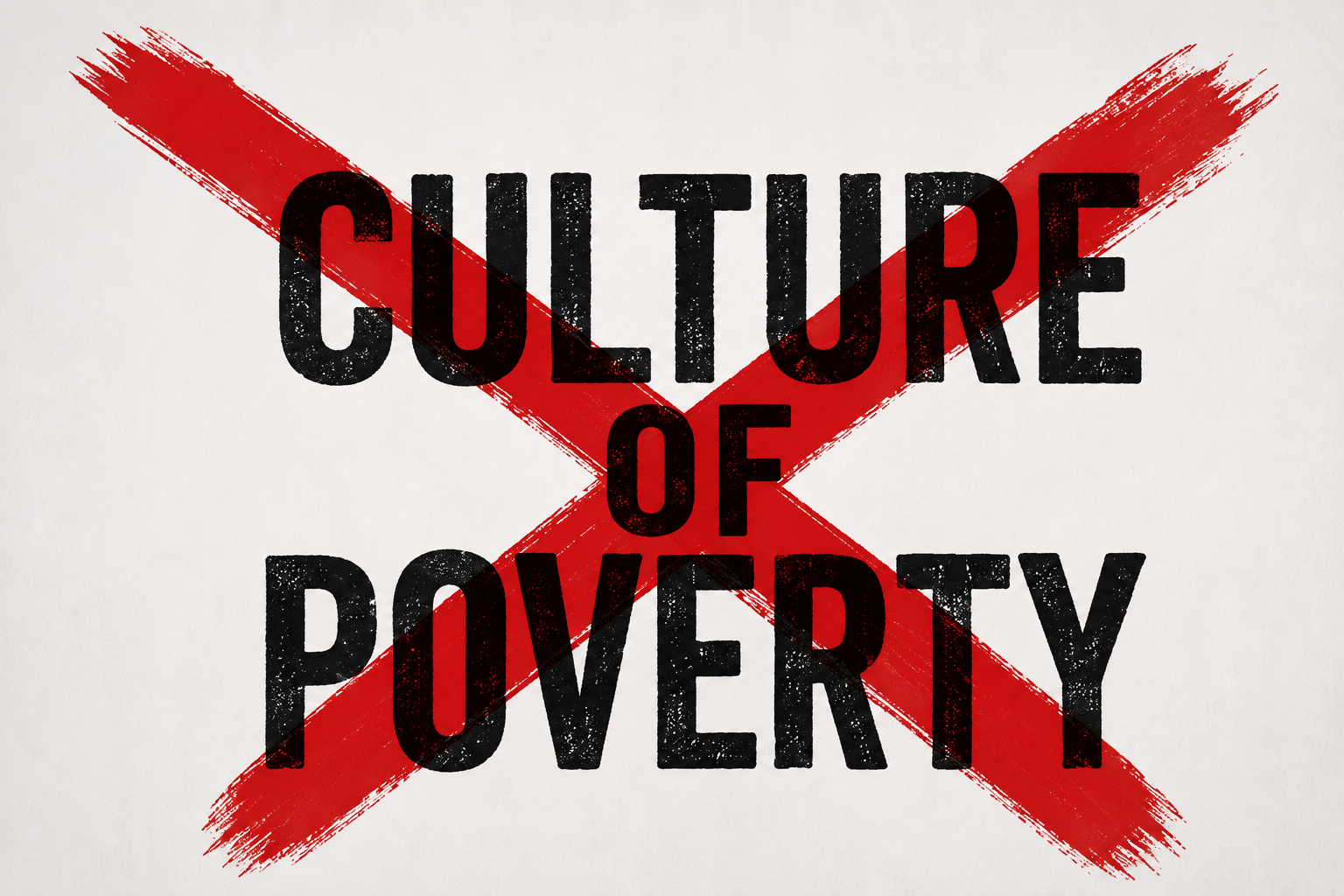
This morning one of my Facebook friends asked what people thought about the phrase “culture of poverty.” The responses have been thoughtful, passionate, and at times painful.
I’m grateful she asked the question because the phrase comes up often in my world of social services and social justice. It appears in books, professional trainings, and conference presentations. For many people, it’s presented as an accepted way to understand why people living in poverty make certain decisions or develop certain coping strategies.
I have to admit something. I detest the phrase.
I grew up poor. Because of that, discussions about a supposed “culture of poverty” don’t feel abstract or academic to me. They often leave me feeling small, stereotyped, and pigeonholed. I don’t like feeling that way.
Before I explain why, I also want to acknowledge something important.
Many friends and colleagues whom I deeply respect have attended trainings on the “culture of poverty” and genuinely found them helpful. Some say those trainings helped them better understand the survival strategies people develop when they lack stability or resources. Others say they became more compassionate or learned to communicate more effectively with clients. If that’s the result, I’m glad.
Trying to understand people better is always worthwhile. My disagreement isn’t with people who want to learn.
It’s with the experts who present “culture of poverty” as though it were a coherent explanation for why poor people behave the way they do.
Most notably, it’s with the work of Ruby Payne, whose ideas have become enormously influential in education and human services despite being widely criticized by many researchers for relying heavily on anecdotal observations and broad generalizations rather than rigorous evidence.
The biggest problem I have with the phrase is that it asks us to see poverty through the lens of individuals rather than through the systems that create and perpetuate poverty in the first place.
Culture implies shared norms, shared values, shared expectations, and shared ways of living.
Poverty certainly influences people. It creates stress. It forces impossible choices. It changes how people think about risk, security, and the future.
But influence is not destiny. And it certainly isn’t culture in the way the term is often used.
When we start describing “the culture of poverty,” it’s remarkably easy to slide into stereotypes. Poor people supposedly value different things. Handle conflict differently. Think differently. Plan differently. Parent differently.
Maybe some do. Maybe some don’t.
The problem is that once we’ve attached those characteristics to an entire group, we’ve stopped seeing individuals. We’ve replaced curiosity with assumptions.
Instead of asking, “What happened to this person?” we begin asking, “What do people like this usually do?” Those are very different questions.
So here are the questions I’d rather ask. Would parenting matter more than income alone?
My mom read to me. She taught me my ABCs, my colors, and—most importantly—she believed in me. That probably had a far greater influence on my life than the fact that we couldn’t afford much.
Could mentors matter more than peers? No one in my family had gone to college. None of my friends expected me to go, either. I certainly didn’t. But my high school guidance counselor who sat me down and insisted that my future could be much bigger than I imagined.
Could race, disability, gender, mental health, geography, trauma, discrimination, and simple luck all interact with income in ways that make every person’s experience of poverty unique?
Could rural poverty look different from urban poverty? Could poverty in Appalachia differ from poverty on a Native reservation, in Minneapolis, or in the Mississippi Delta?
Could two children growing up on the same block have entirely different lives because one had non-violent adults while the other experienced abuse?
Of course they could.
Which is why I struggle with the idea that there’s a single “culture of poverty” waiting to explain it all.
The phrase is simply too neat for something so messy. Too simple for something so complicated. Too confident for something that should make us humble.
For me, poverty isn’t primarily a cultural problem. It’s an economic condition that shapes people’s opportunities, their stress levels, their health, and sometimes even the architecture of their developing brains. It is also profoundly influenced by policies, wages, housing, education, discrimination, access to health care, family support, and countless other factors.
If we reduce all of that to a “culture,” we risk blaming people for adapting to circumstances they did not choose. And we risk overlooking the structures that make poverty so difficult to escape.
That is why the phrase troubles me so deeply. Not because I oppose learning. Not because I deny that poverty changes people. But because I know—from my own life—that no single cultural explanation can capture the complexity, resilience, heartbreak, potential, and diversity of the millions of people who happen to be poor.
They deserve better than a stereotype dressed up as a theory.