An adage in organizing for justice is that while our opponents may have more money than we do, our power comes from the people. That idea is both inspiring and, in many cases, true. We may not have the largest budgets, the most lobbyists, or the most institutional power, but we can draw on something those resources cannot easily manufacture: people who care deeply about an issue and are willing to act together.
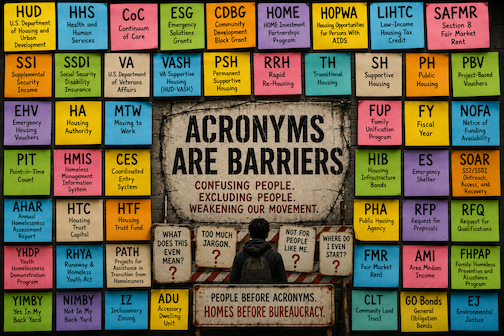
Yet there is a strange contradiction in how many advocacy campaigns operate. We talk about the importance of building people power, but then we often communicate in ways that make people feel like outsiders. An inspiring, straightforward idea about how to tackle an issue can quickly disappear beneath a sea of acronyms, jargon, and technical speak. Language that was intended to help organize people can instead become a barrier to participation.
Consider campaign names. Organizers often begin with a straightforward, aspirational title that tells people exactly what the campaign is trying to accomplish. But then, almost inevitably, the name gets shortened into an acronym that only insiders understand. “Keep Our Neighborhoods Strong” becomes KONS or the KONS campaign. To those already involved, the shorthand may seem convenient. To everyone else, it means absolutely nothing. The acronym hides rather than communicates the purpose of the campaign.
This matters because people do not walk into a movement already knowing its vocabulary. A potential volunteer, new activist, or community member should not have to decode a campaign’s language before they can understand why the campaign exists. If the first few meetings are filled with unfamiliar acronyms and insider terminology, people can quickly conclude that everyone else knows something they don’t. Some will ask questions. Others will quietly assume they are behind and never come back.
Jargon creates a similar problem. Oxford defines jargon as “special words or expressions that are used by a particular profession or group and are difficult for others to understand.” Every profession has it, and advocacy—in my case, housing advocacy—is no exception. The problem isn’t that jargon exists; it is that we too often use it when speaking to the very people whose participation we need.
At its worst, jargon creates a divide within a movement between the campaign “experts” and everyone else. The experts understand the terminology, the process, and the unwritten rules. They come up with the strategies and actions, while everyone else is expected to participate in a campaign has been designed for them. The result is a subtle but important shift: instead of building a movement of people who understand the problem and feel empowered to help solve it, we create a group of people who are waiting to be told what to do.
Technical language can reinforce that same dynamic. Insiders know the complicated aspects of the game. They say things like “engrossment,” “FHPAP,” and the “third committee deadline.” They understand what these terms mean, when they matter, and how they fit into the legislative process. Using them casually can unintentionally communicate, “We know how this works. You don’t.”
I’m being a little harsh. Acronyms, jargon, and technical language absolutely have their place. When campaign planners are working with one another, shorthand can save time and make conversations more efficient. If everyone in the room already understands what a term means, there is little reason to spell it out every time. Technical expertise is also valuable. Movements need people who understand complicated legislative, legal, political, and organizational systems.
But expertise should not build a wall around part of a movement.
In almost every other setting, we should put more time and care into speaking in ways that draw people in rather than demonstrate what we know. We should ask ourselves whether someone who has never worked on a campaign, attended a legislative hearing, or participated in an organizing effort would understand what we are talking about. If the answer is no, we should find a clearer way to say it.
This isn’t simply about being polite or making meetings easier for newcomers. It is about power. If we believe our greatest resource is people, then we should communicate in ways that allow more people to understand, contribute, question, and lead. A campaign should not require people to learn a secret language before they are allowed to participate meaningfully.
When parts of a potential base immediately feel lost, they may still follow instructions. They may show up at the rally, sign the petition, make the phone call, or send the email. But something important is lost when people are merely following directions. Their street smarts, personal experiences, creativity, relationships, and ideas may remain on the sidelines because they don’t yet feel authorized to contribute.
And those may be precisely the resources a campaign needs most.
If we want people power, we should make sure people can understand the language of the movement. The goal shouldn’t be to make everyone an expert in our terminology. The goal should be to make our expertise accessible enough that more people can become leaders themselves.
Plain language isn’t dumbing down our message. It is opening the door.
FULL DISCLOSURE: I admit that, despite my efforts to do otherwise, I often use acronyms, jargon, and technical language because it feels natural to me. Yes, I need to work on my advocacy, too. If people are our greatest source of power, the least I can do is make sure they can understand what I’m saying.