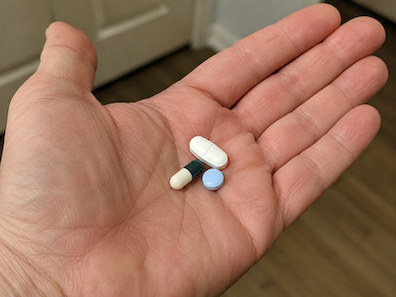
The mental health medication cocktail I’ve relied on for the past several years to keep me “normal” has stopped working.
That sucks.
But I also know this is often part of life for people who live with chronic anxiety and depression.
At some point, you and your doctor find the right combination of medications. They help you feel like yourself again. Calm when calm is appropriate. Joyful when life calls for joy. Angry when anger is warranted. In other words, your emotions begin matching reality instead of overwhelming it.
You hope it will stay that way forever.
Sometimes you’re lucky enough to get several good years.
And then, in what seems out of nowhere, the medications simply stop doing what they once did.
I’ve been fortunate. My current combination worked for five or six years. During that time I was, for all practical purposes, a mentally healthy guy. I could handle life’s ordinary frustrations and even many of its extraordinary ones.
Looking back, though, I think the medications began losing their effectiveness sometime last summer.
Friends and family may remember that August 2014 felt a lot like what I’m experiencing now. By the time I was ready to seek help, however, that episode had passed. I convinced myself I was okay and never revisited whether my treatment needed to change.
Since then, there have been skirmishes, then battles, and now an all-out war with two illnesses that so often travel together: anxiety and depression.
Six weeks and a day ago, everything began falling apart.
I’ve written about pieces of that experience already—running away from work because the anxiety became unbearable, describing the feeling of “brick-brain” depression, and sharing the music that reminds me I’m not alone.
Yesterday, I met with a psychiatrist for the first time in a long time.
After reviewing a questionnaire about the past month of my life (which was every bit as unpleasant as you’d imagine) and talking with me at length, she looked at me and said, “Something’s got to change. Right?”
I nodded. She was right.
The medications that had protected me for years were no longer doing their job. As she put it, once that protection disappeared, the anxiety and depression simply poured out.
I know I’m beginning what will probably be a difficult journey. I’m not going to pretend otherwise.
But I also know something equally important: I need to get better. I can get better.
Finding medications that work again is part of getting there.
I’m equally grateful for therapy. And I’m open to lifestyle changes that have evidence behind them—exercise, sleep, nutrition, mindfulness, and a handful of other complementary approaches. But for someone like me, whose anxiety and depression have been chronic, medication isn’t optional. It’s part of staying healthy, just as regular taking of medication is needed for those who have high blood pressure.
One reason I write about this is because finding the right medication can be a frustrating process.
Even if the first medication your doctor prescribes eventually becomes the right one, the first few weeks can be rough. Depending on the drug—and on the wonderfully strange ways our brains respond differently—you might experience headaches, dizziness, nausea, fatigue, weight changes, or even a temporary increase in anxiety or depression.
Sometimes you make it through that transition and arrive at something that feels wonderfully ordinary. Normal.
Sometimes you don’t. Sometimes the medication simply isn’t the right fit.
Then you work with your doctor to taper off one medication and gradually begin another. All the psychiatric medications I know about can’t be stopped overnight without risking difficult withdrawal symptoms, so patience becomes part of the treatment.
Since my diagnosis, I’ve relied on four different medication combinations. I’ve never been fortunate enough to have a single medication do the job by itself.
One of those combinations was an absolute disaster.
I had almost no physical energy. I gained a significant amount of weight. My depression worsened. The only thing that improved was my anxiety, and the tradeoff simply wasn’t worth it.
Fortunately, my doctor recognized what was happening and helped me transition again.
That period lasted several difficult months. One medication combination stopped working. The next one failed spectacularly. Then, finally, we found the combination that gave me five or six years of stability.
Those difficult months were worth it. That’s one of the reasons I’m writing this today. First, because I want to be transparent about what this process actually feels like. Second, because I want anyone going through something similar to know that the difficult part doesn’t necessarily last forever.
Even the medication that caused me to gain weight didn’t define the rest of my life. Eventually, through diet and exercise, I lost all of those pounds—and then some. Today I weigh about what I weighed when I was twenty years old.
My yoga instructors often end class with a simple reminder: Everything is temporary. I’m trying to hold on to that.
The discomfort of finding the right medication is temporary. This season of anxiety and depression is temporary. And the possibility of feeling like myself again is worth every difficult step it takes to get there.
The rest of my life is too important to spend trapped in this current hell. The rest of my life is too important not to keep searching for normal.